

Salts Acidic Basic Or Neutral
Salts that Produce Bones Solutions
When dissolved in h2o, a basic salt yields a solution with pH greater than seven.0.
Learning Objectives
Distinguish basic salts from not-bones salts
Key Takeaways
Central Points
- In acid - base chemistry, salts are ionic compounds that effect from the neutralization reaction of an acrid and a base.
- Basic salts comprise the conjugate base of a weak acid, so when they deliquesce in water, they react with h2o to yield a solution with pH greater than 7.0.
Key Terms
- basic salt: the production of the neutralization of a stiff base of operations and a weak acid; its anion is the conjugate base of the weak acid
In acid-base of operations chemistry, a common salt is defined as the ionic compound that results from a neutralization reaction between an acid and a base. As such, salts are composed of cations (positively charged ions ) and anions (negative ions), and in their unsolvated, solid forms, they are electrically neutral (without a net charge). The component ions in a table salt tin be inorganic; examples include chloride (Cl−), the organic acetate (CH3COO−), and monatomic fluoride (F−), as well as polyatomic ions such every bit sulfate (SO4 ii−).
The Reaction of a Basic Salt in Water
In that location are several varieties of salts, and in this section nosotros volition consider basic salts. What makes a basic common salt basic? It is due to the fact that the anion in the salt is the conjugate base of a weak acid. For a generalized anion B-, the internet ionic reaction is:
An instance of a basic table salt is sodium bicarbonate, NaHCO3. The bicarbonate ion is the cohabit base of carbonic acrid, a weak acid. Therefore, it reacts with water in the following fashion:
Considering information technology is capable of deprotonating h2o and yielding a basic solution, sodium bicarbonate is a bones salt.
Other examples of bones salts include:
- Calcium carbonate (CaCO3)
- Sodium acetate (NaOOCCH3)
- Potassium cyanide (KCN)
- Sodium sulfide (NaiiSouthward)
Find that for all of these examples, the anion is the conjugate base of a weak acid (carbonic acid, bisulfate (2nd dissociation step of sulfuric acid), acetic acid, hydrocyanic acrid, hydrogen sulfide).
Conjugate Bases of Weak vs. Strong Acids
Keep in mind that a salt will only exist basic if information technology contains the conjugate base of a weak acid. Sodium chloride, for instance, contains chloride (Cl-), which is the conjugate base of operations of HCl. But because HCl is a stiff acrid, the Cl- ion is not basic in solution, and information technology isn't capable of deprotonating water.
Sodium Bicarbonate: Because the bicarbonate ion is the conjugate base of carbonic acid, a weak acid, sodium bicarbonate will yield a basic solution in h2o.
Salts that Produce Acidic Solutions
When dissolved in h2o, acidic salts form solutions with pH less than seven.0.
Learning Objectives
Explain the formation of acrid salts and their effects on a solution's pH.
Key Takeaways
Key Points
- Acid salts incorporate a hydrolyzable proton in the cation, anion, or both; for case, the salt ammonium bisulfate (NH4HSO4) contains an acidic proton in both the cation and the anion.
- To determine the acidity / alkalinity of a hydrolyzable anion, compare the Ka and Kb values for the ion; if Ka > Mb, the ion is acidic; if Kb > Yarda, the ion is basic.
Key Terms
- acid salt: a salt that yields a solution with pH less than 7.0
- hydrolyzable: capable of dissociating in water
Salts With a Hydrolyzable Cation
When dissolved in h2o, acidic salts will yield solutions with pH less than 7.0. This is due either to the presence of a metal cation that acts every bit a Lewis acid (which will be discussed in a later on concept), or, quite usually, due to a hydrolyzable proton in the cation or the anion. Salts with acidic protons in the cation are most ordinarily ammonium salts, or organic compounds that comprise a protonated amine group. Examples include:
- ammonium (NH4 +)
- methyl ammonium (CH3NH3 +)
- ethyl ammonium (CH3CHtwoNH3 +)
- anilinium (CviHviNHtwo +)
An example of an acid table salt is one containing any of these cations with a neutral base, such every bit ammonium chloride (NHfourCl).
Salts With Hydrolyzable Protons in the Anion
Acid salts can likewise incorporate an acidic proton in the anion. Examples of anions with an acidic proton include:
- bisulfate (HSOiv -)
- dihydrogen citrate (H2C6H5O7 -)
- bioxalate (HO2CtwoO-)
Each of these anions contains a proton that will weakly dissociate in h2o. Therefore, salts containing these anions—such as potassium bisulfate—volition yield weakly acidic solutions in water.
Determining Acidity or Alkalinity of a Hydrolyzable Ion
From the previous concept, we know that salts containing the bicarbonate ion (HCOthree -) are basic, whereas salts containing bisulfate ion (HSOiv -) are acidic. We decide whether the hydrolyzable ion is acidic or bones by comparing the Ka and 1000b values for the ion; if Ka > Kb, the ion will exist acidic, whereas if Kb > Thousanda, the ion will be basic.
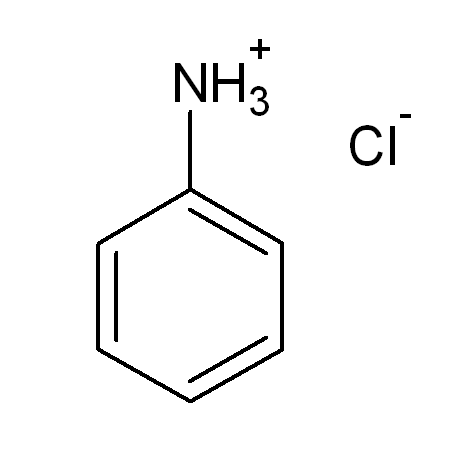
Anilinium chloride: Anilinium chloride is an example of an acid table salt. The NH3+ group contains an acidic proton capable of dissociating in solution; therefore, a solution of anilinium chloride in pure h2o volition have a pH less than seven.
Overview of the Acrid-Base of operations Properties of Salt
Some salts, such equally ammonium bicarbonate (NHivHCOiii), comprise cations and anions that can both undergo hydrolysis.
Learning Objectives
Predict the pH of a solution of a salt containing cations and anions, both of which participate in hydrolysis.
Key Takeaways
Central Points
- Basic salts result from the neutralization of a strong base with a weak acrid.
- Acid salts result from the neutralization of a strong acid with a weak base.
- For salts in which both cation and anion are capable of hydrolysis, compare Ka and Mb values to make up one's mind the solution 'due south resulting pH.
Key Terms
- neutralization reaction: a reaction between an acid and a base in which water and a table salt are formed
- hydrolysis: a reaction with water in which chemical bonds interruption
- salt: in acrid-base of operations chemistry, i of the products in a neutralization reaction
Summary of Acidic and Basic Salts
As we have discussed, salts can course acidic or basic solutions if their cations and/or anions are hydrolyzable (able to react in water). Basic salts grade from the neutralization of a potent base and a weak acid; for example, the reaction of sodium hydroxide (a strong base of operations) with acerb acrid (a weak acrid) will yield h2o and sodium acetate. Sodium acetate is a basic table salt; the acetate ion is capable of deprotonating water, thereby raising the solution's pH.
Acrid salts are the converse of basic salts; they are formed in the neutralization reaction between a potent acid and a weak base of operations. The cohabit acid of the weak base of operations makes the salt acidic. For instance, in the reaction of hydrochloric acid (a strong acrid) with ammonia (a weak base), h2o is formed, along with ammonium chloride. The ammonium ion contains a hydrolyzable proton, which makes it an acid salt.
Salts in Which Both Ions Hydrolyze
The following is a more complicated scenario in which a table salt contains a cation and an anion, both of which are capable of participating in hydrolysis. A expert instance of such a salt is ammonium bicarbonate, NH4HCO3; like all ammonium salts, it is highly soluble, and its dissociation reaction in water is as follows:
However, equally we have already discussed, the ammonium ion acts every bit a weak acrid in solution, while the bicarbonate ion acts as a weak base. The reactions are equally follows:
Because both ions tin hydrolyze, volition a solution of ammonium bicarbonate be acidic or basic? Nosotros can determine the answer past comparing Ka and Thousandb values for each ion. In this case, the value of Mb for bicarbonate is greater than the value of Ka for ammonium. Therefore, bicarbonate is a slightly more than alkaline than ammonium is acidic, and a solution of ammonium bicarbonate in pure h2o will be slightly basic (pH > 7.0). In summary, when a salt contains two ions that hydrolyze, compare their Ka and One thousandb values:
- If Ka > Kb, the solution will be slightly acidic.
- If Kb > Ka, the solution volition be slightly basic.
Licenses and Attributions

Salts Acidic Basic Or Neutral,
Source: https://www.coursehero.com/study-guides/boundless-chemistry/acid-base-properties-of-salts/
Posted by: robinsondelent.blogspot.com
0 Response to "Salts Acidic Basic Or Neutral"
Post a Comment