

World On A Turtle's Back
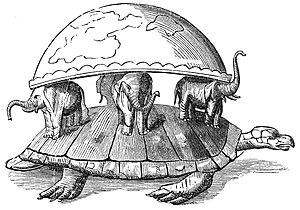
An 1877 cartoon of the earth supported on the backs of iv elephants, themselves resting on the back of a turtle.
The Earth Turtle, also called the Cosmic Turtle or the Earth-bearing Turtle, is a mytheme of a behemothic turtle (or tortoise) supporting or containing the world. It occurs in Hindu mythology, Chinese mythology, and the mythologies of the indigenous peoples of the Americas. The comparative mythology of the Globe-Tortoise discussed by Edward Burnett Tylor (1878:341) includes the counterpart World Elephant.
India [edit]
The Earth Turtle in Hindu mythology is known every bit Akupāra (Sanskrit: अकूपार), or sometimes Chukwa. An example of a reference to the Earth Turtle in Hindu literature is institute in Jñānarāja (the author of Siddhāntasundara, writing c. 1500): "A vulture, whichever has merely trivial strength, rests in the sky property a snake in its beak for a prahara [iii hours]. Why can [the deity] in the class of a tortoise, who possesses an inconceivable potency, not concur the Earth in the heaven for a kalpa [billions of years]?"[one] The British philosopher John Locke made reference to this in his 1689 tract, An Essay Apropos Human Understanding, which compares one who would say that properties inhere in "substance" to the Indian, who said the world was on an elephant, which was on a tortoise, "only being again pressed to know what gave support to the broad-backed tortoise, replied—something, he knew not what".[2]
Brewer'southward Dictionary of Phrase and Fable lists, without citation, Maha-pudma and Chukwa as names from a "pop rendition of a Hindu myth in which the tortoise Chukwa supports the elephant Maha-pudma, which in turn supports the world".[three]
Prc [edit]
In Chinese mythology, the creator goddess Nüwa cut the legs off the giant sea turtle Ao (simplified Chinese: 鳌; traditional Chinese: 鰲; pinyin: áo ) and used them to prop upwards the sky later Gong Gong damaged Mount Buzhou, which had previously supported the heavens.[4]
N America [edit]
The Lenape creation story of the "Great Turtle" was offset recorded betwixt 1678 and 1680 by Jasper Danckaerts. The belief is shared by other indigenous peoples of the Northeastern Woodlands, most notably those of the Haudenosanee confederacy,[5] and the Anishinaabeg.[6]
The Jesuit Relations contain a Huron story concerning the World Turtle:
'When the Father was explaining to them [some Huron seminarists] some circumstance of the passion of our Lord, and speaking to them of the eclipse of the Sun, and of the trembling of the earth which was felt at that time, they replied that there was talk in their own country of a great earthquake which had happened in former times; but they did not know either the time or the crusade of that disturbance. "There is nonetheless talk," (said they) "of a very remarkable darkening of the Lord's day, which was supposed to take happened considering the great turtle which upholds the earth, in changing its position or place, brought its shell before the Sun, and thus deprived the world of sight."'[seven]
In mod media [edit]
The Discworld series, created by Terry Pratchett, takes place on a fictional world that is a flat disc sitting on tiptop of four elephants astride the trounce of a giant turtle named Great A'Tuin.
In the volume Mon Begins on Saturday by Arkady and Boris Strugatsky, a disc upon elephants on a turtle is said to have been discovered by a educatee who entered an platonic world of imagination.
In the volume Information technology by Stephen King, Pennywise's archenemy is a behemothic turtle named Maturin.
In the kickoff of the offset chapter of A Cursory History Of Fourth dimension, an old woman says:"What you have told the states is rubbish. The earth is really a flat plate supported on the back of a giant tortoise."
In philosophy [edit]
The regress argument in epistemology and the space backslide in philosophy often use the expression "turtles all the way downwards" to bespeak an explanatory failure based on an explanation that needs a potentially space series of boosted explanations to support it.[ commendation needed ]
See likewise [edit]
- Turtle Isle (Native American sociology)
- Turtles all the mode down
- Earth Serpent
- Earth Tree
- Zaratan
References [edit]
- ^ Toke L. Knudsen, Indology mailing list.
- ^ Locke, John (1689). An Essay Concerning Human Agreement, Book II, Affiliate XXIII, department 2
- ^ Brewer'due south Dictionary of Phrase and Fable, 15th ed., revised by Adrian Room, HarperCollins (1995), p. 1087. as well 14th ed. (1989).
- ^ Yang, Lihui; An, Deming; Jessica Anderson Turner (2008). Handbook of Chinese Mythology. Oxford Academy Press. p. 182. ISBN978-0-19-533263-6.
- ^ Why the World is on the Back of a Turtle - Miller, Jay; Man, Purple Anthropological Institute of Great Britain and Republic of ireland, New Serial, Vol. 9, No. two (Jun., 1974), pp. 306–308, including farther references inside the cited text)
- ^ Robinson, Amanda; Filice, Michelle (November 6, 2018). "Turtle Island". The Canadian Encyclopedia. Historic Canada. Retrieved February six, 2022.
For some Indigenous peoples, Turtle Island refers to the continent of North America. The proper noun comes from various Indigenous oral histories that tell stories of a turtle that holds the world on its back. For some Ethnic peoples, the turtle is therefore considered an icon of life, and the story of Turtle Island consequently speaks to various spiritual and cultural beliefs.
- ^ "Front end Folio". puffin.creighton.edu. 11 August 2014.

World On A Turtle's Back,
Source: https://en.wikipedia.org/wiki/World_Turtle
Posted by: robinsondelent.blogspot.com
0 Response to "World On A Turtle's Back"
Post a Comment